Thursday, July 21, 2011

White horses, flamingoes and ancient fortresses

Frid 8 our destination is an overnight stopover in Montagnac but we make a detour on the way to St Maries de la Mer - a sea-side village at the heart of the Carmargue. The Camargue is a huge triangle-shaped alluvial plain covering around 750 km2 and is famous for its swamps, salt marshes, flamingoes, black long-horned bulls, and white horses. This is the land of cowboys (known as Gardians), gypsies, flamenco music,and bull fights (but not to the death - thankfully these beautiful beasts live to see another day).

It is a stunning landscape and we pass many manades (ranches) where both Camargue horses and bulls are bred. By the roadside, on these ranches, are covered stalls where these horses stand in the shade waiting for people to hire them - many are saddled ready to go while others are just waiting patiently  amongst the flies and heat for their turn.


We take a stroll around the town - the sun, clear blue skies and Spanish style buildings makes this town glaringly bright and sunglasses are a must. The shops are highly commercialised and here you can find traditional Camargue herdsman-style saddles, western shirts in bright Provencal fabrics, and boots - beautiful western boots with elaborate designs and in all styles and colours.


St Maries de la Mer edges the Mediteranean - the sea is a safe swimming haven for families and the beaches are ideal for sun lovers of all shapes and sizes. We find a little place by the rocks to eat our lunch.


While we see many horses and bulls, we only catch a glimpse of a few flamingoes - their pink-ness atop tall spindly legs just catching our eye as we drive by. There are many other birds in the Camargue and we see grey and white herons by the dozens.

The Carmargue is a stunning area and one that justifies more time spent exploring its wildlife, beaches and horses -  perhaps next time.

Our hotel for the night is just on the outskirts of Montagnac and we discover it by chance and very nearly drive past. We are very excited to find it has a swimming pool - our first in France - pure watery, cool bliss!

Our travels include many different roads - 'A' roads (motorways - 130 kmph), 'D' roads (secondary roads between provincial towns - 90 kmph) and little back roads/lanes (with no markings and sometimes only single laned - 50-70kmph). To avoid paying tolls, we often take the 'D' and smaller roads - we get to see more of the countryside and experience the villages this way.

Our satellite navigator (Tom Tom) tells us what speeds we need to keep to. It also helps us find our way out of villages and towns - as our sense of direction is still in confusion (and probably won't come right until we are back in NZ).

Edging these smaller roads are colourful wild flowers - poppies, sweetpeas, spindly scabiosa (pincushion) and other pretty wildflowers/weeds I don't recognise.

Deep ditches line the roads and sometimes tall trees come right up to the edge of the tarmac like tall soldiers creating a guard of honour. We are surprised and more than pleased to find that all the roads (even the little lanes) are sealed.

Sat 9 we are on our way to Carcassonne - we only know that it is a medieval walled city known as la Cite, so we are unprepared for the sight that comes into view as we drive up to a massive stone fortress, complete with towers and turrets. We quickly discover that la Cite is a popular tourist site as we join hundreds of others trying to find car parks.


We follow the crowds across a drawbridge and through the gates of the fortress. It is 30 deg + and we find ourselves in a hot, narrow street  crammed with people and shops. La Cite is very commercialised and its cobblestoned streets and medieval buildings are filled with souvenir shops, restaurants and places to stay.


We find our accommodation for the next three nights - the YHA. Our hosts Michel and Michelle greet us and immediately make us feel welcome - Michel with his wonderful sense of humour (and also speaks English fluently).


The YHA is right in the middle of la Cite and has modern facilities. We are lucky enough to share a room instead of being separated in single sex dorms (even luckier that we don't have to share it anyone else).


Each morning we enjoy breakfast in the courtyard. The YHA turns out to be a wonderful retreat from the busy-ness of la Cite and we enjoy meeting other travellers from around the world.


In the evening, we find a restaurant for a drink and meal. There is a bit of a commotion around the tables and we are suddenly approached by a young man dressed in fish nets, skirt and wig who wants us to buy two beers for 4 euros - we are happy to oblige but negotiate for a beer and wine for 3 euros instead. We discover he is about to be married and is on a night out with his mates and has to complete a series of challenges.


Each evening, we explore the shops and the fortress, taking in the atmosphere. One night a group in the courtyard next door practices a medieval play, another night the lively tune of a saxophone, from a distant restaurant, drifts through our window as we lie awake in our beds - too hot for sleep, and yet another night we enjoy the rhythmic beating of kettle drums, played by two young girls, as we walk in the late evening around the outer walls of the fortress.


Sun 10 we decide to take a short cruise on the Canal de Midi, to give us a bit of an insight of what our own canal journey will involve. We travel 15 km all up and through two locks twice. The Canal du Midi is 240 km long and is lined with hundreds of Plane-trees or Cypress to stabilise its banks. It's a very slow, pleasant way to travel and we are looking forward to our own canal adventure.


Mon 11 we decide to head out of town and drive  into the hills of Brousses to visit le Moulin la Papier - one of the last operating paper mills in France. We park amongst the trees and walk along the road to the mill. The landscape reminds us so much of home as the forest around us is very similar to the West Coast forests back home. Down a well-trodden path we hear water and then suddenly come across an old stone building beside a stream - we arrive at the paper mill.


Our young guide speaks French but periodically she translates into English for us - we also get the idea of how it all works through viewing the drawings and machinery. The history of paper making is interesting and was originally invented by the Chinese.


Back in Carcassonne, it is another hot afternoon and we just have time for a quick lunch before making our way to the Grand Tournot de Chevalerie - an historical show that features jousting and challenges between the knights and their horses.


It's fun, fast and exciting, especially when you are right up front with your camera. I get a few good shots close to the action just a metre or so from the horses' hooves and a good spattering of sand down my neck but it's worth it.

Challenges include jousting and showing off their skills by slicing apples with their swords at a gallop, picking up  rings with long wooden spears, and scooping up flags off the ground without getting off their horses.  


The knights finished their challenges with a duel (one or two swords) to determine the winner!


We enjoy our time in this ancient city but it's time to move on and leave the fortress to all the other tourists who will each discover its secrets and beauty in their own way!


kiwis2go are loaded2go again!

Sunday, July 10, 2011

A taste of Provence...

Frid 1 July we leave our idyllic little bay and head to Nice to pick up our hire car for the next 12 days - it's a new Ford Focus 1.6 TDI Trend 6-speed manual and it's left hand drive. It takes Max only minutes to suss out how everything works and he is quite pleased to find that the clutch and brakes are all the same as for driving a right-hand car. Driving on the motorway is a good introduction to left-hand drive with no fear of drifting into oncoming traffic but with speeds up to 130km. Provence here we come!


We get our first experience of the Mistral - a very strong provencal wind - when we stop to eat in Carpentras. We are at McDonald's - not our favourite but the only place open and where we know exactly what to expect. The Mistral blows in through the courtyard and sweeps nearly everything right off the table including the drink containers.


Our destination is Venasque, a lovely old village perched on a hilltop in the Vaucluse region. The road from Carpentras is narrow and has no centre line so driving this takes immense concentration as we try to keep to our side of the road.

The road up to the village is steep and windy with many switchbacks which we don't enjoy the first drive up, however after a few days, it is a challenge we overcome - if only the French drivers keep to their side of the road!


We park just outside the village and walk our luggage through a tunnel and along the main street until we find Impasse de l'Horloge - a tiny dead end street with a brown door that leads to our villa.

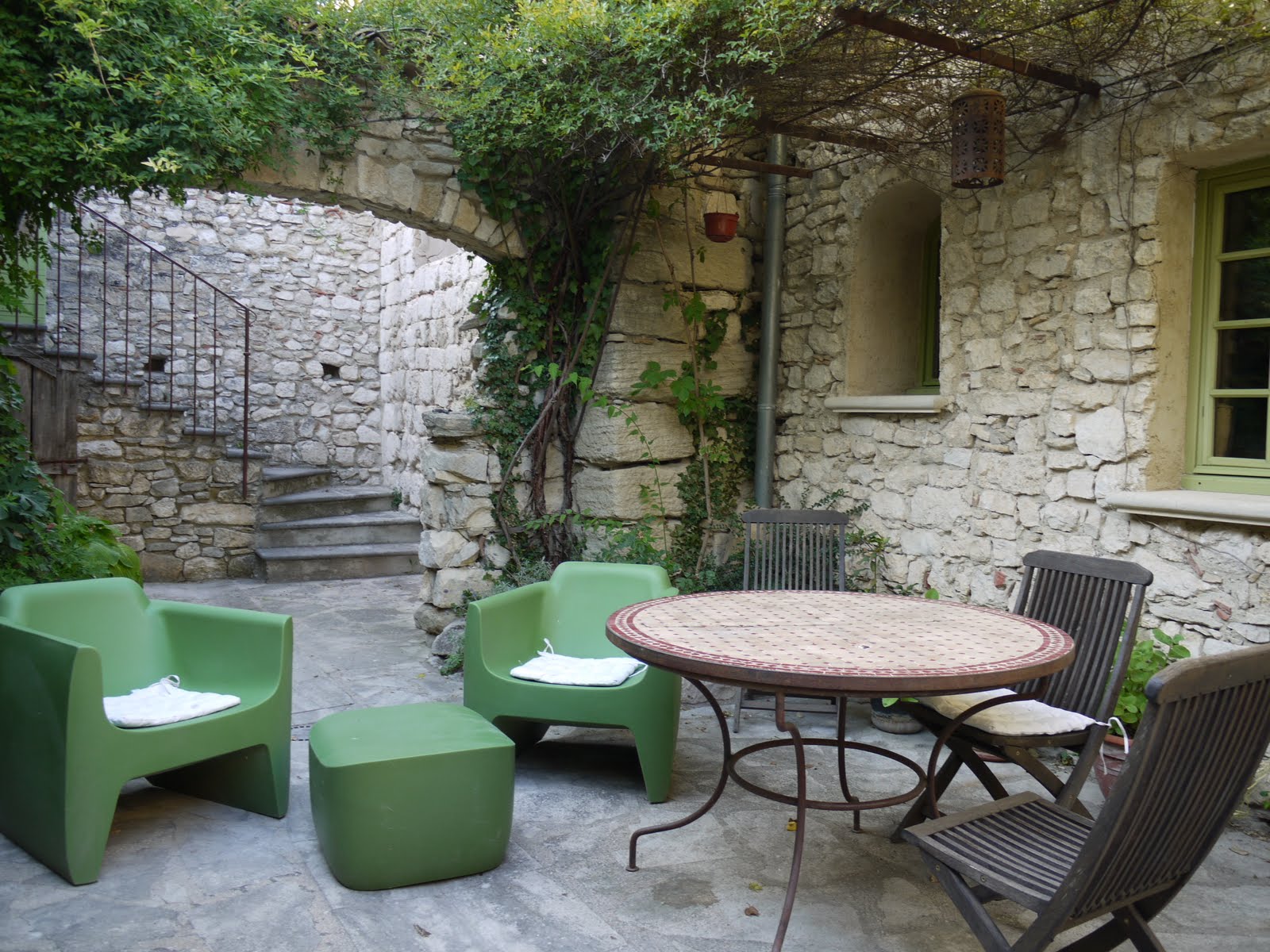
Our first impressions: we fall in love with it straight away. The stone villa with its courtyards, trees and delightful character immediately remind us of our time living in Central Otago. The villa has everything we could possibly wish for the next seven days - fully-equipped kitchen, TV, WiFi, dishwasher, fan and lovely big super king-size bed with ensuite upstairs.


Venasque is one of the many perched villages amongst the Vaucluse Hills - built high above the valleys for protection and the beautiful views. It is also classified as one of 'The Most Beautiful Villages of France' and we discover this during our evening walk.


We are also delighted to find, on our first evening, a little street market setting up - selling wine, cheese, pastries, sausages, fruit, berlingots (little fruit flavoured lollies) and vegetables.


Sat 2 - Sun 3 there is much to see and many suggested drives around Provence - and for this, a car is essential. Visiting the markets is high on our list - there is at least one in a different village each day.

We visit the l'Isle sur la Sorgue market. It is hot, colourful, and crowded, with everything on offer - a great source for traditional provencal fabrics, tablecloths and brightly coloured traditional pottery. Isle sur la Sorgue is also a mecca for antique lovers.


Mon 4 we wind our way to Mont Ventoux and stop at Bedoin for the market - it's a cooler day and the experience is quite pleasant. And for Max - there are several bike shops - we both get a few bargains!


We stop to eat a picnic lunch on the road side as recommended by many but gi-normous ants think we are on the menu so we quickly decide that a picnic out of the car boot is a much better idea. The bugs here are bigger than any others we've seen - we've seen wasps, with red wings, 10 times bigger than those at home, big black bumble bees and huge ladybirds.


Mont (Mount) Ventoux stands like a giant guardian over the valleys and plains. Its bare and barren looking summit can be easily seen from Venasque. It is a pleasant drive up the mountain through scrubby forests (where ironically we see many picnic tables). We pass plenty of cyclists on their way to the top - it's a long steep climb - some cycling, some walking their bikes, and one getting a tow, hanging onto side mirror of a van. We stop to offer assistance to a cyclist who's had a nasty accident but his buddies have already called an ambulance so we move on.

As we get close to the summit, vegetation gives way to what looks like snow but is, in fact, course white limestone scree where very little grows except perhaps the odd little alpine poppy.

At the top, we look across the valleys and plains on either side of the mountain but there is a haze which limits our view. Mont Ventoux is often included in the Tour de France, so Max is happy to have made it up this very special mountain, even if by car. It is a windless day, which is good as when the Mistral blows on the mountaintop, it can take small vehicles with it but, so we are told, it also produces deep blue clear skies.


There is a boulangerie (bakery) and a greengrocer shop in our little village and Max enjoys visiting these each morning for supplies, especially those from the bakery where he finds tantalising little tarts for supper - it's his walk of shame - his obsession to experience a new tart each day. If we lost weight in the UK, we are surely putting it back on again here in France.


Mon 5 we drive to Orange (pronounced 'oh ronge' but with a roll of the tongue on the 'r'). Here in the heat of the day we visit the Theatre Antique D'Orange - an amazing Roman theatre built during Emperor Augustus' reign and dating back to 27-25BC.


It has an intriguing past. In the early times it hosted many plays and shows with lurid themes (until the Christians came and put a stop to it); it was used for meetings and lectures; as a prison; turned into a village within its walls; and finally from 1925-37, it was excavated to return as near as possible to its origins. Gone now are the three levels which held up to 122 marble columns and once graced the 37m high, 103m long and 1.8m thick Great Wall - only one column remains. We climb, in the heat, to the top of the 'cavea' - tiered circle of seating which accommodates up to 10,000 people, to experience the accoustics. Voices from below easily reach our ears. The theatre now hosts modern singers such as Tina Turner, Police and numerous other international performers.

Our next visit is to the Pont du Gard, an ancient Roman aquaduct built with three levels to carry not only water but also people and carts. It is only a short trek from the carpark, in 37 deg, to this famous tourist attraction but well worth the sweat and exhaustion.

The Pont du Gard is the tallest of all the Roman aquaducts at 48m and took only five years to complete. The sheer size and engineering of this three-tiered hand made bridge is truly astounding. It was one of many, along with other bridges, tunnels, and siphons, built to take 20 million litres of water 50km daily from Uzes to Nimes.


When we return to the visitor centre we are pleased to discover overhead misters that send out mists of cooling vapour - sheer bliss. We later experience these, to our delight, in cafes too.

Wherever we drive or walk, we hear the loud buzzing of the cicadas. The cicada is seen embroidered on teatowels, printed on tablecloths and made into pottery and soap figures - it's symbolic of the area.

Each night we explore 'our' village, taking a different route and going beyond the village walls - finding tracks, walking roads and even discovering a cemetery down the hill and the Notre Dame de vie convent in the valley floor below.

Each night, I take my camera and document 'les chats du Venasque' - the cats of Venasque - there are a few and, as cats do, they laze about in the warm evenings on stone walls, in doorways and on windowsills - just waiting for me to catch them in the act of doing nothing.


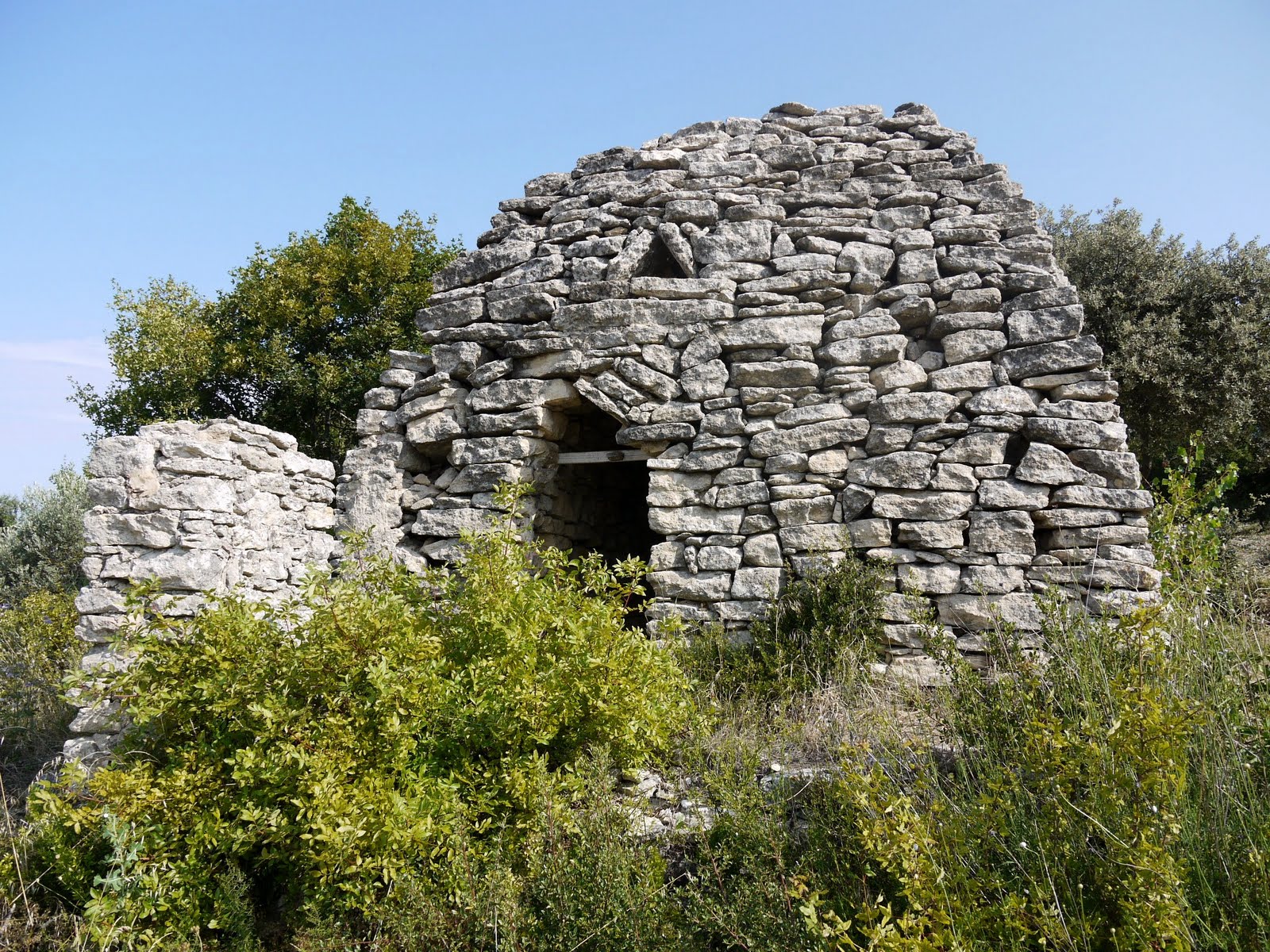
Thurs 7 we drive through steep gorges to a very pretty but commercialised 'perched' village called Gordes. We leave the shops and hype behind and explore the little streets, tunnels, and stairways. We also discover a 'borie' near the carpark - a dry-stone beehive-shaped dwelling usually meant for one person to live in - there are many scattered across Provence and, indeed, across the world - all with different names and shapes depending on the country.


We leave the borie behind and head to Roussillion, another delightful 'perched' village, but one with a difference. For this village is in the heart of the Ochre Hills of Luberon. We take the trek with others along a red sandy path and view the steep yellow and orange/red coloured moonscape-like quarry. Our feet turn red in the sand and we take on an orange glow from the bright reflections from the ground. A most unusual but stunning attraction - we refrain from buying little bottles of layered colour sand and finally head towards home to wash our feet and sandals.


We stop on our way home to visit the Musee de la Lavende, where I learn the difference between fine lavender and lavendin -  fine lavender grows from seed and only in the Provencal hills above 800 metres, whereas lavendin grows throughout the world between 0 and 800m and is propagated from cuttings. I also view old distilleries and learn about the strong lavender history of the area. We discover some of the many lavender fields during our outings - some are well cultivated while others are quite unruly and overgrown.


From late afternoon, the local swallow population go crazy - flying in frenzied groups above our heads and calling out in their high pitched whistles - swooping down through the narrow streets, darting in and out of holes in dry-stone walls and from under the tiled eaves, and if you're unlucky, landing a poop on your head or in your drink. It's a stunning spectacle and each evening we are treated to this energetic bird dance in the sky.


On this, our last evening, we are treated to the haunting melodies and medieval songs performed by a small group called Le Trek. These men and women travel the small villages during summer to give these live performances. They move about the streets singing and playing their instruments - it is lovely to watch (they are dressed in costume) and equally so to hear their unique sound drift to across the rooftops and into our courtyard. Of course, it is also fun to follow them with the camera!

Upon reflection, the provencal landscape reminds us a little of Central Otago, Wanaka and even a little of Te Anau - its rugged-ness. It has been a wonderful week but time now to move back towards the coast and the Languedoc region...

Tuesday, July 5, 2011

Sun, sea and blue skies...

 Tues 28 we catch a TGV high speed train from Paris to Nice, covering some 950km in 5 hours and 33 mins, with speeds at times up to 320 kph. I love traveling on the train and this is the 'best of the best' of trains for me. It's really fast, and smooth, too! We are lucky to score our seats on the top level (doubledecker train) where we enjoy the countryside views from a better angle.

The seating is spacious and comfy with foot rests so we sit back and enjoy the ride. We speed past hectares of crops, vineyards and the small villages of Burgundy; through tunnels and across viaducts; our ears pop as we climb to higher altitudes and skim over the plains and hills of the Rhone Alps to sunny Provence-Alpes-Cote d'Azur on the south coast of France.


Villefranche-sur-mer

Nice is hot and busy when we arrive but we get a taxi instantly and soon we are on our way to Villefranche-sur-mer, just two bays and twenty minutes away. Luckily, our driver speaks some English so we converse along the way.

Here in Villefranche, we see all the stunning colours and images we've come to expect - those depicted in all the books and magazines. Ochre coloured buildings with brightly painted shutters and doors, peeling paint and orange tile roofs - all framed by an azure sea and deep blue sky - this really is the French Riveria.


We can hardly believe we are here experiencing all this - our travels keep us black and blue as we pinch ourselves along the way to make sure it is truly real.

Villafranche is picturesque with steep hillsides dotted with houses perched one above the other, and the bay, which hosts a variety of motor boats, sail and super yachts of all shapes and sizes.

Our hotel is not new, in fact a little shabby in places, but it is welcoming, clean, comfortable, has air conditioning and excellent service. We are happy enough as it has all the French character and charm we could wish for.

We take a stroll through the Old Village just below the hotel and experience our first real French meal. Our waiter is a young and, well, rather gorgeous Frenchman, and anything he suggests - wine, water, bread, quiche and mozarella appetisers - I, apparently (according to Max) eagerly accept. And why not! Our main dish is Tartare de Filet de Boeuf (Steak Tartare) with a side salad and a few large chips. The steak is raw, minced and infused with herbs and strong cheese. It is delicious and very rich in flavour.

Weds 29 & Thurs 30 we spend our time exploring this delightful little village - we walk up steep stone steps and through narrow alleyways, and discover St Michael's Church hidden amongst the houses. It is a cool haven inside and smells of oldness and incense.

We find a medieval vaulted covered street, Rue Obscure, where people used to take shelter in World War II. We drift in and out of little gift and clothing shops - we come across two that sell only white clothing - for white is the essential dress code of the Cote d'Azur - it's cool and fresh looking.


We stroll around the Citadel - an old fortress beside the town and built between 1554 and 1557 - from here there are delightful views across the bay.

We wander around the gardens, visit an exhibition of pottery figurines and castles portraying historical events and life. The Citadel now houses the Town Hall, a convention centre, three museums and an open air theatre.
Down by the waterfront, I visit St Peter's Chapel, built in the 1750s in a baroque Italian-style. It is beautifully decorated with line drawings and trompe l'oeil by Jean Cocteau - a writer, artist and film-maker.

Each morning we start with a delightful breakfast at the hotel - we choose from toast, fruit, cereal, croissants, fruit pastries, boiled eggs and cheese - a good breakfast sets us up for most of the day and we often replace lunch with just a coffee. It's a good time to meet other travellers too - some from France, some from England and others from Norway.


The days start with a haze across the bay, turning all the rich colours into soft muted tones. We make use of these times to visit the farmers market by the park for fruit and vegetables, and to the supermarche to stock up on drinking water and other essentials.

We learn to have some inside time as the heat rises during the middle of the day. The streets become deserted then as all the shops close for 2-4 hours, re-opening later in the day for the evening trade.


Each day we visit the beach and spend time cooling off in the sea - a delightful contrast to the busy-ness of Paris. The beach is dotted with umbrellas and people. Heads bob in the sea and women (young and old) sunbathe topless on the beach while children catch little fish in the shallow waters nearby. Yachts dance to a soft breeze across the harbour and their masts sway in time to the rolling tides. Yes, life on the Riviera is very relaxed.


The bay is deep enough for cruise ships, up to 95 metres, to anchor off shore. And because of this depth, Villefranche is the most visited cruise ship port of call in France. An Israeli cruise ship anchors in the bay during our stay and we watch a a small boat ferry people to the little harbour. The restaurants all jump into action and a mini market appears along the waterfront. Bags, clothes, jewellery, artwork, soap, linen and hats are all on offer.


One evening while out on a walk, we are waved into a private carpark above the bay by a stranger to share his evening view. He is of English origin but his accent is a mix of many languages from his transcient childhood. He is an author who writes under the name of Nicholas Anderson NOC. His book is about the SIS and MI6 and about to become a movie. He is friendly and we enjoy our conversation with him.


Another evening we buy pizzas and a bottle of wine. Everywhere we go we hear the harping sirens of the police.

We believe they are in pursuit of two kiwis last seen in the park eating pizzas out of zee box, drinking wine out of zee little plastic cups and feeding zee pigeons. I wonder who they are...!